
Originally presented at the University of Rochester on invitation of the Curating the Middle Ages Working Group, Central New York Humanities Corridor, December 2023. It has been lightly edited. Images are slide screenshots. Except where otherwise stated, all information is current as of November 2023.

Good afternoon, and thank you to Anna and Irina for inviting me to speak today. I appreciate the freedom to choose the topic of my lecture, and I opted to delve into something new. As a result, I find myself posing more questions than providing answers. However, this exploration may bring about greater clarity and direction for future research.
Today, I’ll be discussing what I term the “manuscript digital divide.” The central question revolves around what influences the selection process in digitization. This query arose during my engagement with Suzanne Paul’s book chapter on the curation and display of digital medieval manuscripts in the Cambridge Companion to Medieval British Manuscripts.
Who Decides What Gets Digitized?
While the chapter broadly covers manuscript digitization, Paul highlights a critical aspect: who decides what gets digitized?
Paul says: “Although the creation of digital images of medieval manuscripts has been transformative, it is important to acknowledge that at this point in time, only a very small proportion of the medieval manuscripts that survive as a whole or in fragmentary form have been digitized. Why and how were these ones selected?” (Suzanne Paul, “The Curation and Display of Digital Medieval Manuscripts” The Cambridge Companion to Medieval British Manuscripts. Cambridge University Press, 2020. pp. 267 – 283)
Paul continues by making two claims:
“Very few institutions fund digitization of their collections from their core budget; by and large, the costs of digitization have to be met from external sources.”
And
“Early manuscripts, vernacular manuscripts, illuminated manuscripts, and those with illustrious provenance are at the front of the queue for digitization.”
Now, let’s delve into these two aspects—the funding question and the selection of manuscripts for digitization. Regarding funding, the common belief is that digitization is constrained by budget limitations. Many institutions rely on external sources, be it government funding, grants, or donations. For the sake of simplicity in this discussion, I’ll refer to this as “budget.”
The second point concerns the priority given to certain manuscripts for digitization, with the specific examples given as early, vernacular, illuminated, and those with illustrious provenance.
This paper will explore both the funding and selection processes in detail.
The History of Manuscript Reproduction
Before delving into these claims, let’s briefly touch upon the history of manuscript reproduction. This context is crucial for understanding the evolution of manuscript digitization.
I won’t go into detail here, but I recommend exploring Sian Echard’s talk “‘Secure from the Ravages of Time’: Antiquarian Avatars of Medieval Manuscripts” from the 14th Annual Schoenberg Symposium in 2021 and Bridget Whearty’s book Digital Codicology: Medieval Books and Modern Labor (Stanford University Press, 2022) for a deeper historical perspective.

Shifting to a historical snapshot of manuscript digitization around 20 years ago, I want to share insights from a national survey I conducted for my master’s paper: Medievalists’ Use of Electronic Resources: The Results of a National Survey of Faculty Members in Medieval Studies (University of North Carolina, November, 2022). This survey asked faculty members in medieval studies about their use of electronic resources. Notably, the resources available in 2002 were limited compared to today.
Projects like “Images of Medieval Manuscripts of the Bodleian Library, Oxford” involved scanning images from existing film, a common practice until the early 2000s. Other projects, such as “Early Manuscripts at Oxford University” and “DScriptorium,” showcased a mix of complete digitized manuscripts, selected images from institutional collections, and additional information such as transcriptions and translations. DScriptorium was a project of Dr. Jesse Hurlbut of Brigham Young University, and should not to be confused with Digital Scriptorium (DS). DS was established in 1997 but wasn’t mentioned in the master’s paper, which seems like an oversight 20 years later. DS organized under a consortium in 1999, which set it apart from the institutions that focused on their own collections.
The Magna Carta at the British Library and the Aberdeen Bestiary were significant digitization projects, offering high-resolution images when many projects did not. Additionally, projects like The Electronic Beowulf and The Canterbury Tales Project focused on individual manuscripts, high-resolution images, and added information.
In 2002, the emphasis was on institutional collections, thematic focus, and to a lesser extent on consortia collaboration, as seen in DS. The Electronic Beowulf included images taken under ultraviolet light, so we can see that in 2002 advanced digital imaging techniques were already part of the conversation.
Digital Manuscript Landscape in 2023
Let’s turn to the contemporary landscape and the data I sought for my research. To find relevant information, I turned to the Digitized Medieval Manuscripts Project, abbreviated as DMMap. This project serves as an invaluable resource by mapping institutions that have digitized manuscripts available, particularly focusing on Western medieval manuscripts.

DMMap originated around a decade ago in the Netherlands, initiated by graduate students. The project involves crowd-sourced data, constantly updated with the latest blog post in May 2023 (Note: In December 2024, the May 2023 blog post is still the most recent one). While acknowledging potential data inaccuracies due to its crowd-sourced nature, it provides a valuable starting point to seeing which institutions have digitized their manuscripts.
The project consists of two primary components: the map and the data. The map visually represents the distribution of institutions globally, while the data offers detailed information about each institution’s digitized manuscripts. Notably, I contacted the project team, and they confirmed the ongoing activity and responsiveness to reported issues. (Note: In December 2024, updates to the data have been made as recently as November 27, 2024)

The map showcases a concentration of institutions in Europe, with representation from the United States, UK, Canada, Japan, Australia, New Zealand, and Brazil. Clicking on a specific institution reveals options to explore digitized manuscripts directly or access additional data.

Clicking “Explore additional data” to visit the library’s information page.

A tangent. When I was preparing for this talk in November 2023, I selected the National Library of Wales as my example (for reasons that will be clear later in the talk). But when I clicked on that green button that says “Go to the digitized manuscripts,” I was disappointed to find that the link no longer worked, and I got an error message at the library website.

I went back to the previous page, and found the yellow “Report Data Issue” option.

I filled in a report, and within a couple of days the link in DMMap had been updated to point to the correct page on the NLW website – and it still works in December 2024.

The data section provides a comprehensive view, allowing users to filter based on institution, free cultural works, and quantity (that is, the number of digitized items).

They also provide a data spreadsheet, which I downloaded for further analysis.


My preliminary crunching of the data involved evaluating the number of institutions with digitized manuscripts. Out of 578 institutions (Fisher Library, U. Toronto, was listed twice), spanning 10 countries, the distribution varies, revealing the prevalence of digitization efforts in certain regions. I started by looking at how many institutions in are represented by each country. I didn’t find this information particularly surprising. Many smaller countries have few institutions included in DMMap, while those that have more institutions represented are larger countries, and/or countries known for their manuscript collections and their digitization efforts (Numbers as of November 2023):
| Number of institutions | Country/Countries |
|---|---|
| 1 | Armenia, Brasil, Bulgaria, Croatia, Iceland, Japan, Norway, Slovakia, Vatican, Wales (10 total) |
| 2 | Denmark, Hungary, Portugal, Romania, Russia (5 total) |
| 3 | Canada, Estonia, Finland, New Zealand, Sweden (5 total) |
| 5 | Scotland |
| 6 | Czech Republic |
| 7 | Poland |
| 9 | Australia |
| 11 | Austria, Belgium (2 total) |
| 15 | Spain |
| 18 | Ireland |
| 22 | England |
| 30 | Italy |
| 34 | Netherlands |
| 69 | USA |
| 75 | Switzerland |
| 82 | Germany |
| 149 | France |
Digitization Funding
As a reminder, here is Paul’s claim about digitization funding:
“Very few institutions fund digitization of their collections from their core budget; by and large, the costs of digitization have to be met from external sources.”
I started with with Switzerland. The E-codices project stands out due to its commitment to digitize every manuscript in Switzerland, or manuscripts in other countries that were made in Switzerland.

There are 75 institutions total in Switzerland listed in DMMap. The Congregation du Grant-Saint-Bernard also has its own site listed in DMMap, and The Domschatz der St. Ursen-Kathedrale is in Manuscripta Mediaevalia (Handschriftenportal in December 2024), an online portal for German collections. 74 of these institutions are included in e-codices (Congregation du Grant-Saint-Bernard is not included, but Domschatz der St. Ursen-Kathedrale is).
Looking at data from e-codices itself, we can see that DMMap doesn’t include data for every institution in e-codices. There are 86 institutions from Switzerland in e-codices, with 2,806 total manuscripts. While this means the average institution in Switzerland would have 32.6 manuscripts, we all know that’s not the case. 48 of those 86 institutions have fewer than ten manuscripts, and St. Gallen, Stiftsbibliothek is the outlier on the other end, with 841 manuscripts total.
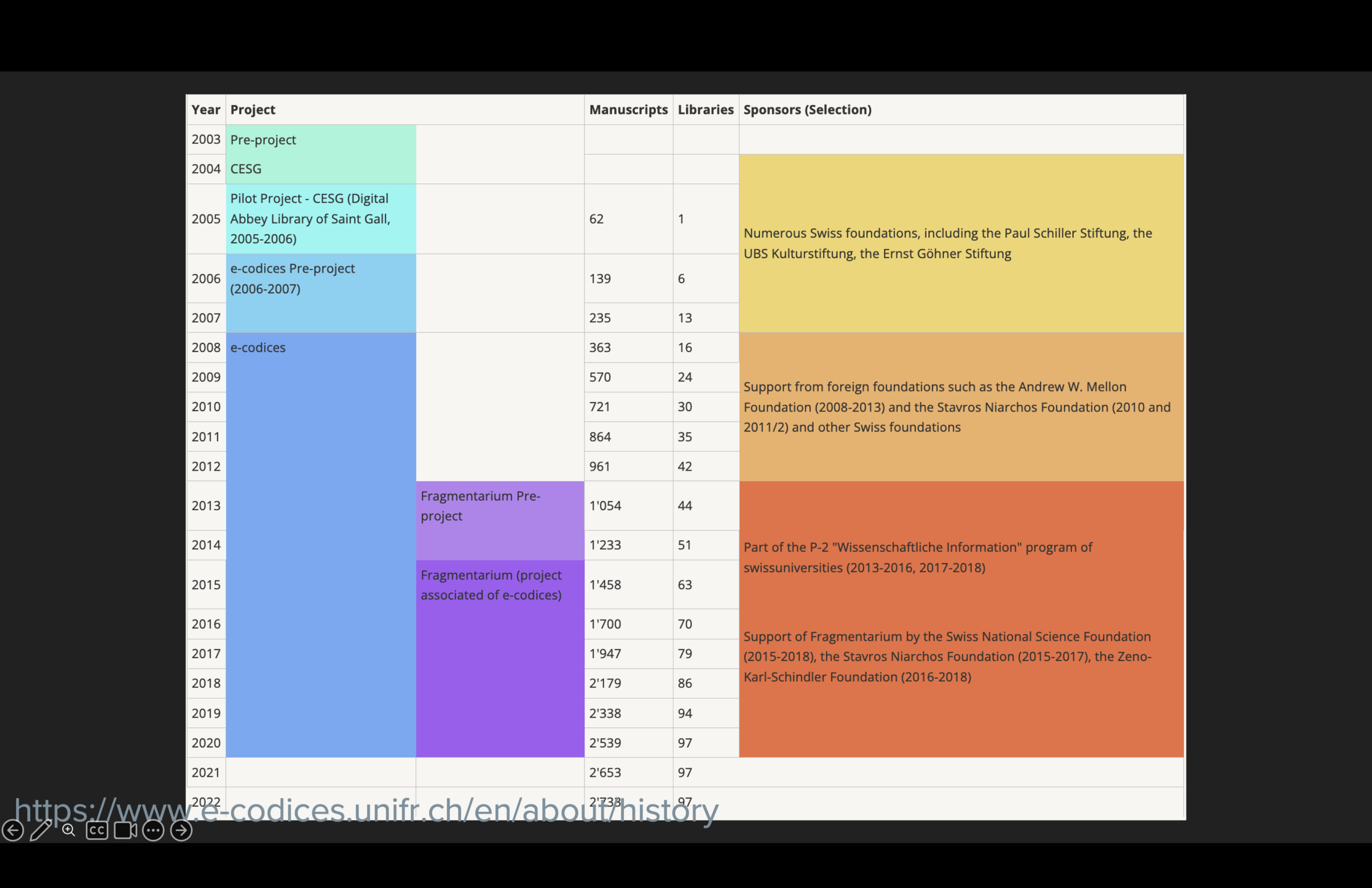
But what about funding? Funding for e-codices has come from many different sources over the years. There are a couple of different sources for tracking funding information. The chart of selected sponsors from the project’s beginning, which is on the “Brief History” page of e-codice’s “About” section, includes (since 2003) various Swiss foundations, Andrew W. Mellon Foundation Foundation, and the Stavros Niarchos Foundation. However this chart is headed “Sponsors (Selection)” so there may be other small foundations not named. There is also a list of current supporting institutions, which as of January 2025 includes many more foundations. The funding for e-codices has been and continues to be substantial.
I want to point out three things about what e-codices has done (beyond, or perhaps in addition to) its funding – in fact, these things no doubt contribute to the great success of this program.
- They digitize complete manuscripts, not portions of manuscripts (say, only the illuminated pages). Yes, it is usual today to digitize complete manuscripts, but in 2003 this was not the case.
- They digitize only Swiss manuscripts (manuscripts in or from Switzerland) which limits the scope.
- The power of building a strong consortium to bring in additional funding and to help keep the project successful over the long term.
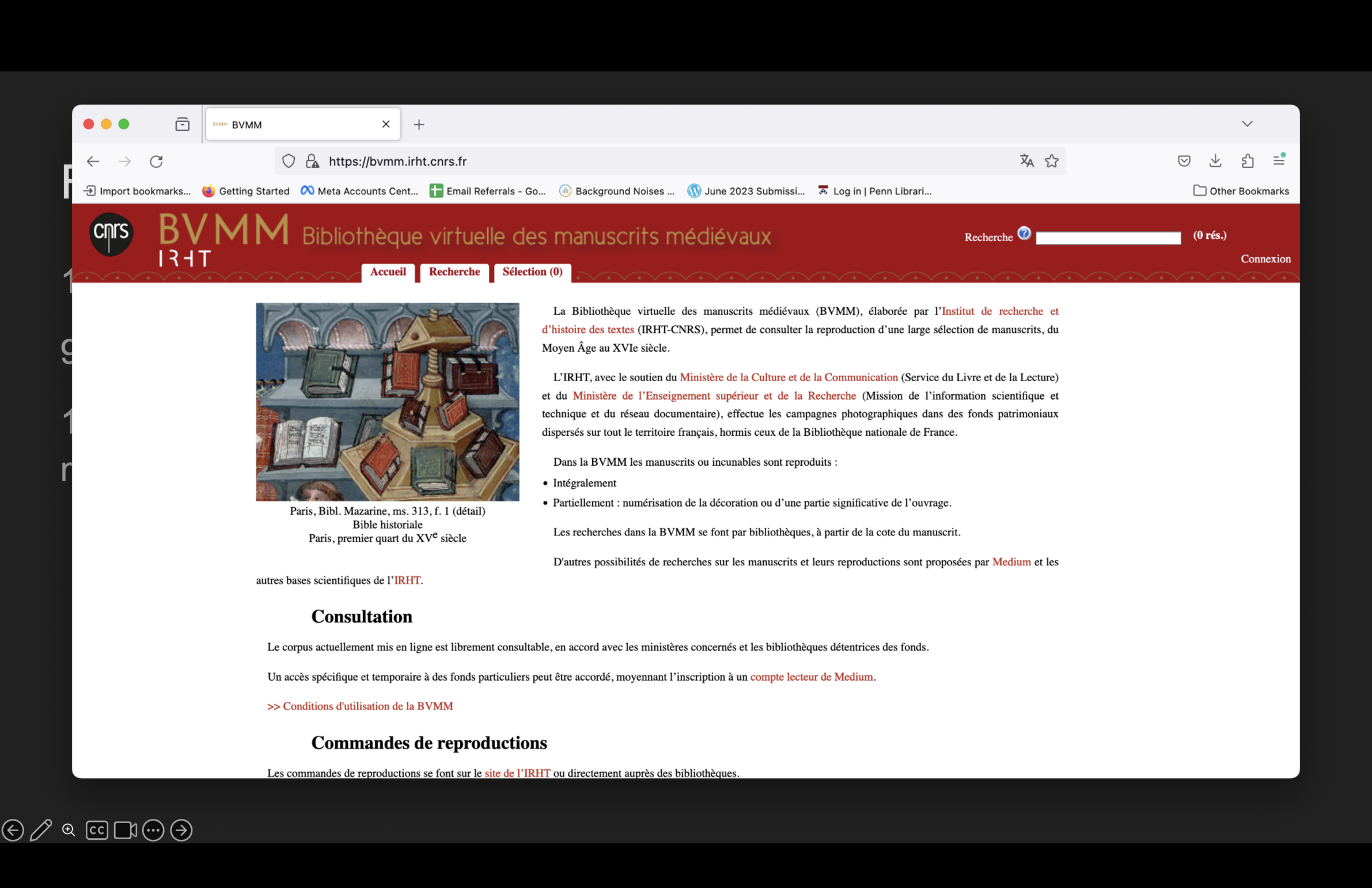
France, with 149 institutions, presents a similar scenario. The CNRS BVVM project, funded by the French Ministry of Culture and Ministry of Research, exemplifies the power of consortia in enabling smaller libraries to participate in large-scale digitization efforts. 118 of the manuscript-holding institutions in France are members of the CNRS BVVM.
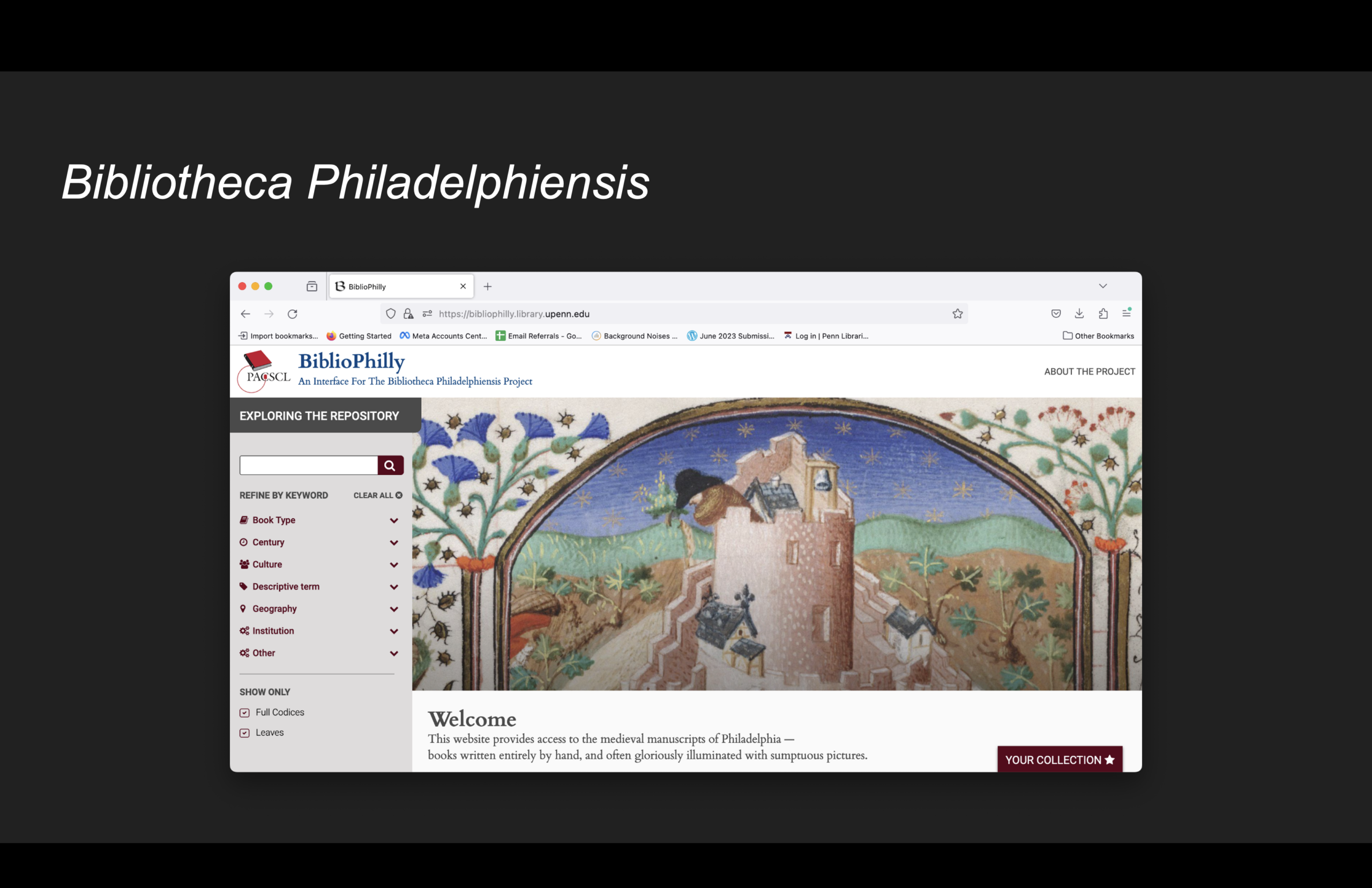
Turning to the United States, the Bibliotheca Philadelphiensis project (BiblioPhilly) provides another example of what can be achieved through external funding and institutional collaboration. Organized by the Philadelphia Area Consortium of Special Collections Libraries (PACSCL), the project ran from 2016 to 2019 with funding from the Council on Library and Information Resources (CLIR), supported by the Andrew W. Mellon Foundation. Fifteen institutions in and around Philadelphia participated, making their medieval and early modern manuscript collections available through a shared digitization effort.
BiblioPhilly brought together 15 institutions from across Philadelphia, institutions with very different collections and resources. The project made 475 codices, along with approximately 1,700 leaves and cuttings, available online. The Free Library of Philadelphia contributed the largest number of manuscripts, while other participants included university libraries, museums, and smaller special collections repositories – some of which own only one manuscript. Some institutions contributed manuscripts digitized specifically through the grant, while others made previously digitized materials available through the project. The resulting collection brought together material that had previously been dispersed institutional collections, creating a much more comprehensive picture of the region’s manuscript holdings.
The project depended on more than grant funding alone. BiblioPhilly essentially acted as a consortium within a consortium, a subset of PACSCL dedicated to medieval and Renaissance manuscripts. Members of the project consortium contributed more than their books. Lehigh University provided administrative and fiscal oversight, Penn Libraries undertook much of the digitization and hosted the images through OPenn, and every institution provided cataloging and metadata support, helping to make the manuscripts discoverable and usable as well as visible.
BiblioPhilly illustrates several of the same principles we saw in e-codices and the BVMM project: digitizing complete manuscripts, defining a manageable regional scope, and building a consortium that can pool expertise and resources. In Philadelphia, collaboration meant that institutions did not need to develop entirely separate digitization infrastructures or raise funds independently for individual institutional projects. Instead, they could participate in a coordinated effort that made their collections part of a larger digital resource. The project demonstrates how external funding, combined with an existing institutional network and shared technical infrastructure, can bring dispersed collections into a single (virtual) collection.
Shifting focus, I want to return to Paul’s second claim:
“Early manuscripts, vernacular manuscripts, illuminated manuscripts, and those with illustrious provenance are at the front of the queue for digitization.”
Briefly, it is not difficult to see the truth in Paul’s claim. Looking again at my master’s paper work from 2002, four projects representing some of the earliest full-manuscript digitization illustrate all four of these points:
Early Manuscripts at Oxford University: included some of the earliest manuscripts containing Old English (including Junius 11, ca. 1000)
Electronic Beowulf: Cotton MS Vitellius A XV, Nowell Codex, ca. 1000, written in Old English, formerly owned by Laurence Nowell and Sir Robert Cotton
The Aberdeen Bestiary: ca. 1200, lavishly illuminated
The Magna Carta (British Library, Cotton Augustus II. 106): one of four copies authenticated with the Great Seal of King John, 1215
Clearly, early in the great experiment of mass manuscript digitization, there was a focus on early, vernacular, illuminated manuscripts with illustrious provenance. It would be interesting to see if that trend still remains today. But that’s not what I am going to do. Instead, I want to complicate this by looking at another vernacular language, and how surviving manuscripts in this language have been treated when it comes to digitization.
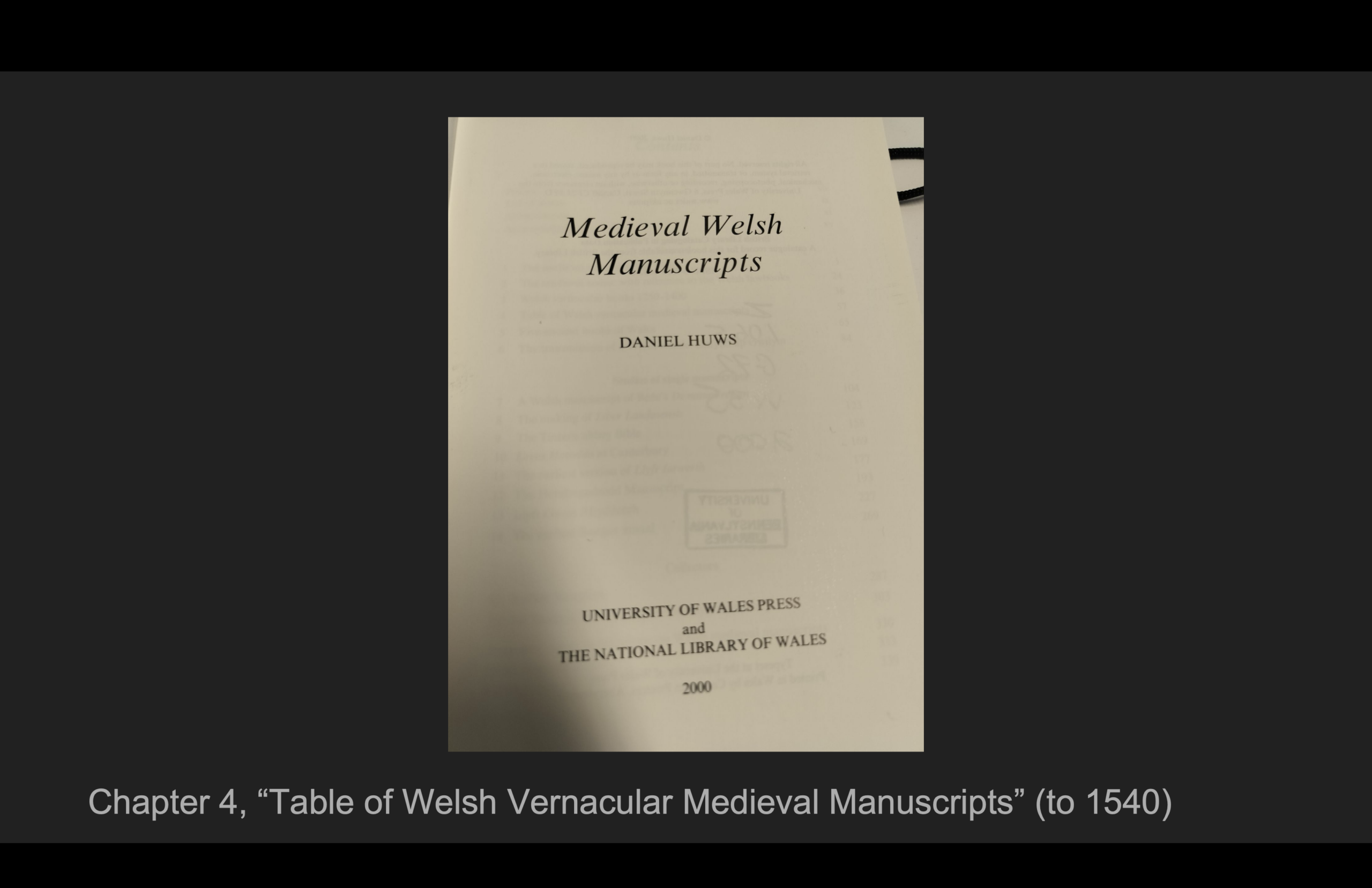
While compiling information during the early stages of this work, I noticed that Wales was represented by only one institution in DMMap, the National Library of Wales, despite the fact that Welsh manuscripts are held by institutions throughout Wales and beyond. Welsh is the vernacular spoken in Wales, and I was curious to see how well represented Welsh-language manuscripts are in digitized collections, in Wales and elsewhere.
I turned to Daniel Huws’ book Medieval Welsh Manuscripts (University of Wales Press and the National Library of Wales, 2000) on Welsh vernacular manuscripts, in particular chapter 4, “Table of Welsh Vernacular Medieval Manuscripts” (to 1540). There are 174 manuscripts in this list. Of these, only 64 had been digitized as of November 2023.
| Institution | #manuscripts | #digitized |
|---|---|---|
| National Library of Wales | 130 | 54 |
| British Library | 20 | 0 |
| Cardiff, Central Library (now Cardiff University?) | 8 | 0? |
| Jesus College, Oxford (on deposit in Bodleian) | 7 | 6 |
| Bodleian Library | 2 | 2 |
| Cambridge, Trinity College | 1 | 0 |
| Cambridge, Corpus Christi College | 1 | 1 (Parker on the Web) |
| Shrewsbury School | 1 | 0 |
| Glasgow University Library | 1 | 0 |
| Bangor University | 1 | 0 |
| Bodorgan (private collection) | 1 | 0 |
| Library Company of Philadelphia (?) | 1 | 0 |
| Rylands Library, University of Manchester | 1 | 0 |
The distribution is strikingly uneven. The National Library of Wales accounts for 54 of these digitized manuscripts, while the British Library holds 20 manuscripts on the list and has digitized none of them. Other repositories have similarly limited digital coverage: six manuscripts at Jesus College, Oxford, were available through Digital Bodleian, along with two at the Bodleian itself and one at Corpus Christi College, Cambridge. Several other institutions hold Welsh vernacular manuscripts, but none of the manuscripts in my list at those institutions have been digitized.
This is a problem that complicates Suzanne Paul’s assertion that vernacular manuscripts are among those “at the front of the queue for digitization.” Which vernacular manuscripts are we talking about? Frankly, I assume the context of her paper is England, and thus she is talking about English vernacular manuscripts, which do appear to be prioritized in digitization efforts in England and elsewhere. (A full study on this would be interesting!)
Welsh-language manuscripts do not appear to have enjoyed the same priority. The figures suggest that a manuscript’s vernacular status alone does not explain its likelihood of being digitized; language, location, institutional resources, and the historical circumstances of a collection all matter. The situation is especially striking when we consider manuscripts held in repositories in England. The British Library’s Welsh manuscripts remain unavailable in digital copies, despite the institution’s substantial digitization activity and the importance of these manuscripts to Welsh literary and cultural history. This disparity invites us to consider the longer history of the relationship between England and Wales, including the unequal power relations through which Welsh language and culture have been marginalized. I would not argue that the figures alone establish a direct causal relationship between that history and contemporary digitization decisions. But the pattern raises important questions about whether the priorities and structures of digitization reproduce older inequalities in practices and policies of cultural heritage digitization.
There is also an economic dimension to this problem. Several institutions in Wales hold medieval manuscripts, but many have only a handful, and the resources available to digitize them are not necessarily comparable to those of larger national and university libraries. Even when a collection contains only one manuscript, digitizing it still requires equipment, staff time, infrastructure, and long-term digital preservation. A national library with an established digitization program can make substantial progress, but smaller institutions may struggle to make their holdings available without external funding or collaborative support. The Welsh example therefore brings together both of the questions raised by Paul: funding affects what can be digitized, and the assumptions guiding selection affect which collections receive attention. The result is that manuscripts can remain digitally invisible not because they lack cultural or scholarly significance, but because the institutions that hold them lack the resources—or the incentive—to make them accessible.
In conclusion, these examples suggest that the manuscript digital divide is shaped by more than the availability of external funding or the perceived significance of individual manuscripts. Switzerland’s e-codices project, France’s BVMM, and Bibliotheca Philadelphiensis demonstrate how sustained funding, a clearly defined scope, and collaboration among institutions can support digitization at scale, including for collections held by smaller institutions. But the Welsh case demonstrates why we must also examine the cultural and historical assumptions that shape our priorities. If early, illuminated, and famous manuscripts are obvious candidates for digitization, and if vernacular manuscripts are supposedly among those prioritized, we need to ask whose vernacular languages and whose cultural heritage benefit from that attention. As Paul herself warns, “there is a risk that this accessibility gap will continue to widen and a new digital canon will form,” in which manuscripts available on screen become the primary objects of study while those without digital copies are overlooked. Addressing this problem requires not only more funding and collaboration, but also a critical examination of how digitization priorities are established. We need to ask not just which manuscripts have been digitized, but which remain inaccessible, whose collections they belong to, and what the consequences of that absence are for the histories we are able to tell.